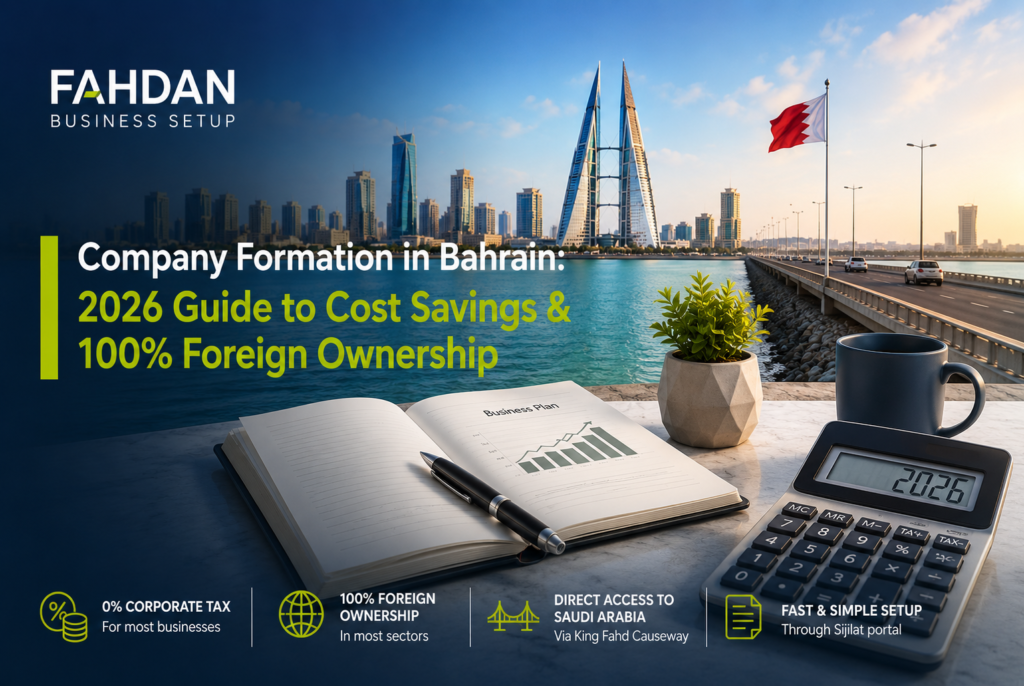
Key takeaway: Bahrain vs Dubai vs Saudi Arabia is the headquarters question every Gulf-bound founder asks in 2026. For SMEs and regional service companies, Bahrain is the most cost-efficient GCC headquarters in 2026 — independent EY research found up to a 48% cost advantage over GCC peers, with no corporate income tax for most businesses, 100% foreign ownership, and direct road access to Saudi Arabia via the King Fahd Causeway.
Dubai wins on global brand visibility and international capital access. Saudi Arabia wins if your revenue depends on Saudi government contracts — its RHQ licence is mandatory for most government tenders and comes with a 30-year 0% tax incentive on eligible HQ activities.
Choosing where to base your Gulf headquarters is a decision worth hundreds of thousands of dollars a year. Office rent, salaries, licensing fees, corporate tax exposure, and access to the Saudi market all differ sharply between Bahrain, Dubai, and Saudi Arabia — and the rules changed significantly between 2024 and 2026.
This guide compares all three jurisdictions using only verified, primary-source data: the 2025 Ernst & Young ‘Cost of Doing Business in the GCC’ study, official tax legislation from Bahrain’s National Bureau for Revenue (NBR), the UAE Federal Tax Authority, Saudi Arabia’s ZATCA, and the Ministry of Investment of Saudi Arabia (MISA). Every figure is dated and sourced — see the verification table at the end.
Bahrain vs Dubai vs Saudi Arabia: How They Compare for a Regional Headquarters in 2026
Bahrain leads on cost and simplicity, Dubai leads on global connectivity, and Saudi Arabia leads on domestic market size and government contract access. The table below summarises the comparison across the twelve factors that matter most. Put simply, the Bahrain vs Dubai vs Saudi Arabia decision comes down to weighing cost against connectivity against market access.
| Factor | Bahrain | Dubai (UAE) | Saudi Arabia |
|---|---|---|---|
| Company setup cost | Lowest in GCC | High | Medium–High |
| Office rental cost | Up to 60% below GCC avg (EY, 2025) | Very high | High |
| Labour costs | Up to 24% below GCC avg (EY, 2025) | High | High + Saudization quotas |
| Licensing & business fees | Up to 85% lower (EY, 2025) | High (free zone & mainland fees) | Medium–High |
| Corporate income tax | 0% most sectors; 15% DMTT only for MNEs with EUR 750M+ global revenue | 9% above AED 375,000; 0% for qualifying free zone income | 20% on foreign-owned share; 0% for 30 years on licensed RHQ activities |
| Personal income tax | 0% | 0% | 0% |
| VAT | 10% | 5% | 15% |
| Withholding tax | None | 0% (domestic) | 5–20% (0% for RHQ-eligible payments) |
| Foreign ownership | 100% in most sectors, whole country | 100% in free zones & many mainland sectors | 100% in approved sectors via MISA licence |
| Speed of setup | Very fast (Sijilat portal, days) | Fast | Moderate (more approvals) |
| Access to Saudi market | Direct — King Fahd Causeway (~25 km) | Indirect (flight) | Local presence |
| Cost of living | Low | Very high | Medium |
Sources: EY ‘Cost of Doing Business in the GCC — Financial Services Sector’ (2025); Bahrain Decree-Law No. 11 of 2024 (DMTT); UAE Federal Decree-Law No. 47 of 2022; ZATCA RHQ Tax Rules (16 Feb 2024). Full verification table at the end of this article.
Why Is Bahrain the Most Cost-Effective GCC Headquarters in 2026?
Bahrain combines the lowest operating costs in the GCC with the region’s simplest tax system and direct land access to Saudi Arabia. For SMEs, consultancies, professional services firms, holding companies, and technology businesses, these advantages compound into a materially lower total cost of ownership.
1. Independently Verified: Up to 48% Lower Operating Costs
A 2025 study by Ernst & Young — ‘Cost of Doing Business in the GCC: Financial Services Sector’ — benchmarked direct and indirect annual operating costs across Bahrain, Kuwait, Oman, Qatar, Saudi Arabia, and the UAE. Bahrain ranked as the most cost-competitive location, with up to a 48% overall cost advantage. The categories analysed were office space, talent, business setup fees, taxes, and visa and residency costs.
The specific savings EY identified for Bahrain:
- Up to 24% lower annual labour costs than the GCC average
- Up to 60% savings on office rental costs
- Up to 85% lower annual business and licensing fees
Honest note: the EY percentages come from a financial services / tech hub case study. The direction of the cost advantage holds across service industries, but exact percentages will vary by sector and headcount. Fahdan can build a cost model for your specific structure.
2. The Simplest Tax System in the GCC — With One 2025 Change to Know
Bahrain imposes no corporate income tax on most business activities outside oil and gas, no personal income tax, no withholding tax, and no capital gains tax. A 10% VAT applies to most goods and services.
What changed in 2025: Bahrain became the first GCC country to implement a Domestic Minimum Top-up Tax (DMTT) of 15%, under Decree-Law No. 11 of 2024, effective 1 January 2025. The DMTT applies only to entities of multinational groups with consolidated global revenue of EUR 750 million or more in at least two of the last four fiscal years. SMEs and regional businesses below this threshold are unaffected and continue to pay no corporate income tax.
In practice: if your group’s global revenue is below roughly EUR 750 million, Bahrain remains effectively a zero-corporate-tax jurisdiction for most activities.
3. 100% Foreign Ownership — Across the Whole Country
Most business activities in Bahrain allow full foreign ownership without a local partner or sponsor. Unlike the UAE, where the strongest ownership and tax benefits are tied to specific free zones, Bahrain operates as a whole-country open market: you can locate your office anywhere on the island and keep the same ownership rights.
4. The Only Land Bridge to Saudi Arabia
Bahrain is connected to Saudi Arabia’s Eastern Province by the King Fahd Causeway, an approximately 25 km road link. Teams based in Bahrain can attend client meetings in Khobar, Dammam, or Jubail and return the same day — something no other non-Saudi GCC base can offer. This is why many regional consultancies and service providers run their headquarters from Bahrain while serving Saudi clients daily.
5. Fast, Digital Company Formation
Company registration in Bahrain runs through the Sijilat portal of the Ministry of Industry and Commerce (MOIC). Standard company types — such as a With Limited Liability company (WLL) — can typically be incorporated within days, with far fewer pre-approvals than Saudi Arabia requires.
6. Built for Shared Services and Regional Functions
Because the same headcount costs significantly less than in Dubai or Riyadh, Bahrain is particularly well suited for centralised group functions:
- Finance, accounting, and treasury
- HR shared services and payroll
- Technology, development, and IT support teams
- Legal, compliance, and administration
- Call centres and customer operations
When Is Dubai the Better Headquarters Choice?
Dubai is the right headquarters when international perception, global connectivity, or UAE-based revenue outweigh cost. Choose Dubai if:
- Most of your clients and revenue are inside the UAE
- You need a globally recognised address for international investors, banks, and partners — Dubai’s DIFC and other hubs carry weight that few addresses can match
- Your business depends on world-class aviation links, tourism flows, or global trade infrastructure
- A specific free zone offers regulatory advantages for your sector (e.g. DIFC for financial services, DMCC for commodities)
Tax position (2026): The UAE applies 9% federal corporate tax on taxable income above AED 375,000 (income below that is taxed at 0%). Qualifying Free Zone Persons can still achieve 0% on qualifying income, subject to strict substance, audit, and de minimis conditions. Large multinationals (EUR 750M+ revenue) face a 15% DMTT, as in Bahrain.
Dubai’s structural strengths are real: it remains the Gulf’s most internationally connected commercial hub, and as of 2023 the UAE hosted roughly three-quarters of the regional headquarters of major multinationals operating in the Gulf. But that visibility is priced in — office rent, salaries, and cost of living in Dubai are among the highest in the region.
When Is Saudi Arabia the Better Headquarters Choice?
Saudi Arabia is the right headquarters when your revenue depends on the Saudi domestic market — especially the government. Choose Saudi Arabia if:
- Your primary customers are Saudi government entities or state-owned enterprises
- You bid for government tenders: since 1 January 2024, multinational companies generally cannot contract with Saudi government entities without a licensed Regional Headquarters (RHQ) in the Kingdom (a structured exemption framework for specific cases was introduced in early 2026)
- Most of your revenue is generated inside Saudi Arabia — the GCC’s largest economy by far
- You operate in sectors actively incentivised under Vision 2030: manufacturing, logistics, tourism, mining, or green energy
The Saudi RHQ Programme: Strict Requirements, Strong Incentives
Saudi Arabia’s RHQ Programme — run by the Ministry of Investment (MISA) and the Royal Commission for Riyadh City — has been remarkably successful: more than 600 RHQ licences had been issued by 2026, exceeding the Vision 2030 target of 500, with around 90% located in Riyadh.
The incentives are substantial. Under the RHQ Tax Rules published by ZATCA on 16 February 2024, licensed RHQ entities receive a 30-year renewable incentive of:
- 0% corporate income tax on income from eligible RHQ activities
- 0% withholding tax on qualifying payments (dividends, payments to related persons, and payments for services necessary to the RHQ’s activities)
But the conditions are real. An RHQ must be part of a multinational group with a presence in at least two countries beyond Saudi Arabia and the home country, must perform genuine strategic and management functions from the Kingdom, must meet minimum staffing requirements (including senior executives) within the first year, and cannot conduct revenue-generating commercial activities — those require a separate commercial entity taxed at the standard 20% rate on the foreign-owned share of profits.
Key distinction: the famous ‘0% for 30 years’ applies only to the RHQ entity’s eligible headquarters activities — strategic supervision and administrative support for the group. Your actual Saudi trading or services business still pays standard Saudi corporate tax (20% on foreign-owned profits) plus 15% VAT.
Which Headquarters Location Is Right for Your Business? A 4-Question Test
Answer these four questions to find your likely best fit:
- Where does your revenue come from? Mostly Saudi government → Saudi Arabia (RHQ). Mostly UAE → Dubai. Spread across the GCC → Bahrain.
- How large is your group? Global revenue above EUR 750M → the 15% global minimum tax follows you everywhere, so optimise for operations, not tax. Below it → Bahrain offers a genuine 0% corporate tax base.
- How cost-sensitive are you? If a 30–50% saving on rent, salaries, and fees changes your unit economics, Bahrain is hard to beat.
- Do you need international investor optics? If your fundraising or banking depends on a globally recognised hub address, Dubai justifies its premium.
The Most Cost-Effective GCC Structure for Service Companies in 2026
For companies providing business consulting, corporate services, HR and payroll, accounting and finance outsourcing, company formation, or technology and digital solutions across the GCC, the structure that minimises group overhead while preserving market access is:
| Entity | Role & Rationale |
|---|---|
| Regional HQ — Bahrain | Main operating company and group centre. Centralised finance, HR, technology, and administration. Benefits: lowest GCC costs, 0% corporate income tax (below the EUR 750M DMTT threshold), 100% ownership, daily road access to Saudi clients. |
| Saudi Branch or Subsidiary — Riyadh or Eastern Province | Client-facing entity for Saudi revenue, local invoicing, hiring, and contracts. Required for direct Saudi government work (or a full RHQ licence if government tenders are core to the business). Taxed at the standard Saudi rate on the foreign-owned share. |
| UAE Presence — Dubai (optional) | Add only if you have direct UAE clients or partners requiring a UAE-registered counterparty. A representative office or free zone entity keeps the footprint light. |
This structure delivers lower group overheads, full Saudi market access, tax efficiency for entities below the global minimum tax threshold, easier multinational talent acquisition, and centralised administration — while maintaining presence in all three markets.
Frequently Asked Questions
Can a foreigner own 100% of a company in Bahrain without a local partner?
Yes. Most business activities in Bahrain permit 100% foreign ownership without a Bahraini partner or sponsor, and this applies country-wide rather than only in designated zones. A limited list of activities remains restricted or requires Bahraini participation — confirm the rule for your specific activity before registering.
Does Bahrain have corporate income tax in 2026?
For most businesses, no. Bahrain imposes no corporate income tax outside the oil and gas sector, no personal income tax, no withholding tax, and no capital gains tax; a 10% VAT applies. The one exception: since 1 January 2025, a 15% Domestic Minimum Top-up Tax (Decree-Law No. 11 of 2024) applies to entities of multinational groups with consolidated global revenue of EUR 750 million or more. Companies below that threshold are unaffected.
What is the Saudi RHQ licence and do I need one?
The Regional Headquarters (RHQ) licence, issued by Saudi Arabia’s Ministry of Investment (MISA), allows a multinational to base its regional strategic management in the Kingdom. Since 1 January 2024, it is generally required to contract with Saudi government entities. Licensed RHQs receive a 30-year renewable incentive of 0% corporate income tax and 0% withholding tax on eligible headquarters activities. More than 600 licences had been issued by 2026. If you do not sell to the Saudi government, a standard Saudi branch or subsidiary is usually sufficient.
Is the Saudi RHQ really tax-free?
Only for eligible headquarters activities — strategic supervision, management, and administrative support for the group’s regional entities. The RHQ entity cannot conduct revenue-generating commercial activities; any actual Saudi trading or services business operates through a separate entity taxed at the standard 20% corporate rate on foreign-owned profits, plus 15% VAT. The RHQ also carries substance requirements, including minimum staffing with senior executives in the Kingdom.
How long does it take to set up a company in Bahrain?
Most standard company types can be incorporated within a few working days through the Sijilat portal of the Ministry of Industry and Commerce (MOIC), assuming documents are in order and the activity needs no special approval. With professional support, many businesses complete registration in under a week — measurably faster than the typical Saudi setup, which involves more approval layers.
Is Bahrain or Dubai cheaper for running an office?
Bahrain, by a wide margin. EY’s 2025 GCC cost study found office rental costs in Bahrain up to 60% below the GCC average and annual licensing fees up to 85% lower — while Dubai’s commercial rents and cost of living are among the highest in the region. If your clients don’t require a Dubai address, the savings on rent, salaries, and accommodation are substantial year after year. In the Bahrain vs Dubai vs Saudi Arabia comparison, Bahrain is consistently the cheapest base for a running office.
Can I serve Saudi clients from a Bahrain headquarters?
Yes, within limits. Many consultancies and service providers operate from Bahrain and serve Saudi clients via the King Fahd Causeway (~25 km). However, if you need to issue Saudi-compliant local invoices, sign government contracts, sponsor employees in the Kingdom, or hold a Saudi commercial registration (CR), you will need a Saudi branch, subsidiary, or RHQ. The common pattern is a Bahrain HQ plus a lean Saudi entity.
Can Fahdan set up my company in both Bahrain and Saudi Arabia?
Yes. Fahdan is a business setup consultancy headquartered in Adliya, Bahrain, operating in both Bahrain and Saudi Arabia, with more than 6,000 companies formed across the region. The team handles company formation, commercial registration, PRO services, visas, HR, and ongoing compliance in both markets. Book a free consultation to map the right structure for your business.
Ready to Choose Your GCC Headquarters?
The right structure can cut your annual operating costs by a third or more — or unlock government contracts you could not otherwise win. The wrong one locks you into unnecessary tax, rent, and compliance burden for years.
Fahdan’s consultants work across Bahrain and Saudi Arabia daily. We will compare the real numbers for your specific business, recommend a structure, and then execute it end-to-end: company formation, commercial registration, licensing, PRO services, visas, and ongoing compliance.
Book your free consultation at fahdan.com — and get a side-by-side cost model for your headquarters decision.
Sources & Verification Table (all checked 10 June 2026)
| Claim | Primary Source |
|---|---|
| Bahrain: up to 48% overall GCC cost advantage; 24% lower labour; 60% lower rent; 85% lower licensing fees | EY, ‘Cost of Doing Business in the GCC — Financial Services Sector’ (2025); published via Bahrain EDB (bahrainedb.com), July 2025 |
| Bahrain: no corporate income tax outside oil & gas; companies exempt from CIT | EY MENA GCC location cost analysis (June 2025); Bahrain National Bureau for Revenue (NBR) |
| Bahrain DMTT: 15% for MNE groups with EUR 750M+ consolidated revenue, effective 1 Jan 2025; first GCC country to legislate DMTT | Decree-Law No. 11 of 2024, Bahrain NBR; EY Global Tax Alert (Sept 2024); BDO; KPMG (Feb 2026) |
| Bahrain VAT: 10% | Bahrain National Bureau for Revenue (NBR) |
| UAE corporate tax: 0% up to AED 375,000; 9% above; QFZP 0% on qualifying income; 15% DMTT for large MNEs | UAE Federal Decree-Law No. 47 of 2022; UAE Federal Tax Authority; Ministerial Decision No. 73 of 2023 |
| Saudi corporate income tax: 20% on foreign-owned share of profits; VAT 15% | Zakat, Tax and Customs Authority (ZATCA) |
| Saudi RHQ: 0% CIT + 0% WHT for 30 years (renewable) on eligible activities, from licence date | Saudi Press Agency (5 Dec 2023); ZATCA RHQ Tax Rules, Official Gazette (16 Feb 2024); EY Global Tax Alerts; KPMG |
| RHQ mandatory for Saudi government contracting since 1 Jan 2024; exemption framework added early 2026 | MISA / Mayer Brown (2024); Middle East Briefing (Mar 2026) |
| 600+ RHQ licences issued by 2026, exceeding the Vision 2030 target of 500; ~90% in Riyadh | Ministry of Investment of Saudi Arabia (MISA) announcements, 2026; industry compliance reports |
| RHQ substance rules: multinational with presence in 2+ countries beyond KSA and home country; senior-executive staffing; no revenue-generating commercial activities | MISA RHQ guidelines; ZATCA; King & Spalding analysis (Mar 2024) |
| UAE hosted ~76% of major multinationals’ Gulf regional HQs (2023 baseline) | Arab Center Washington DC (July 2023) |
| King Fahd Causeway: ~25 km road link between Bahrain and Saudi Arabia’s Eastern Province | King Fahd Causeway Authority |
This article is general guidance, not legal or tax advice. Tax rules and fees in the GCC change frequently — confirm current requirements for your specific activity with Fahdan or the relevant authority before acting. Produced by Fahdan — Business Setup Consultancy, Adliya, Kingdom of Bahrain. fahdan.com